lunedì 21 maggio 2007

An Ideal Husband - Oscar Wilde

Lord Goring, Sir Robert Chiltern, Lady Chiltern and Mrs Chevely use their wealth to attain political and social respectability in a British aristocracy during the 1890’s.
Towards the end of the 19th century was the growth of the Aesthetic movement, this is symbolized in Wilde’s play An Ideal Husband through the use of Dandyism and Decadents using the character Lord Goring to display this. Wilde defined Dandyism as “the assertion of the absolute modernity of Beauty” and to relate this to Lord Goring it emasculates his character dramatically. The movement recognises individual freedom and modernity challenging society’s rules and reforms. He isn’t married nor engaged, doesn’t work or represent any political proceedings, he lives an upper class life of wealth and parties and is more worried about his appearance and prefer
The reader knows Mrs Chevely is wealthy due to her dress and she has come from Vienna because in those days the chance to travel was merely for the upper class only, those who could afford it. The idealistic lives of these characters are revealed and turned out to be corrupt and immoral. They use their wealth to gain power and respectability through out their social and political lives not worrying themselves about the real issues that are being raised in the society of the 1890’s. The patriarchy of and upper class English society in the 1890’s places the power and control in the hands of the men. This political party of women demonstrates the emergence of the Suffragette movement that was in place towards the end of the late 19th century, beginning of the 20th century. A life Sir Robert Chiltern had lived before he even married Lady Chiltern and now that Lady Chiltern knows about the secret she to must live an immoral life. For this era the amount of power Lady Chiltern has is very uncommon, women were there to be seen but not heard. Chiltern in the play conforms to these social ideals even though he is morally corrupt due to his devious past, in which he gained his wealth through corrupt means to give him the opportunity to become an upper class citizen and an influential party in the political game, “Wealth has given me enormous power”. Politics to Lady Cheveley is a game, thinking the winners are the most deceitful and conniving people even though she says “one should always play fairly… when one has the winning card” in her case the winning card she thinks is the letter she has telling of Sir Robert Chiltern’s past.

Have a good reading!!! You can read the book online here

PLOT

Robert Chiltern is the ideal husband. Or so his wife believes. But a dinner guest arrives with information about his past that could lead to either blackmail or scandal.

PEOPLE OF THE PLAY

THE EARL OF CAVERSHAM, K.G.
VISCOUNT GORING, his Son
SIR ROBERT CHILTERN, Bart., Under-Secretary for Foreign Affairs
VICOMTE DE NANJAC, Attache at the French Embassy in London
MR. MONTFORD
MASON, Butler to Sir Robert Chiltern
PHIPPS, Lord Goring's Servant
JAMES }
HAROLD } Footmen
LADY CHILTERN
LADY MARKBY
THE COUNTESS OF BASILDON
MRS. MARCHMONT
MISS MABEL CHILTERN, Sir Robert Chiltern's Sister
MRS. CHEVELEY
______________________

THE FILM


Oscar Wilde's 1895 play, An Ideal Husband, was made into a movie in 1947 with a stellar cast. Then, a Russian language version was made in 1980 which we wonder if anyone saw. Now Oliver Parker has "adapted" the play for a new screen version which he also directed.
____________________________________________
At the theatre: click here

The official Web Site of Oscar Wilde includes biography: Click here

giovedì 17 maggio 2007

Salomé - Oscar Wilde


He actually wrote most of Salome in French in Paris during the autumn of 1891. On February 11, 1896, Salomé premiered to mixed reviews at the Théâtre de l'Œuvre in Paris. The play met with a mixed, but generally positive response; many suspected, however, that much of the enthusiastic applause at the curtain fall was actually in support of the author.
The play was first publicly performed in Germany at the Neues Theater in Berlin in 1903. Max Renhardt produced it based on the success of his earlier private production at the Kleines Theater in 1902. The production ran for 200 performances. Richard Strauss, who had been in the audience of that earlier private performance, premiered his opera of the same name at the Royal Opera House in Dresden in 1905. Salome was privately performed in both London and New York that same year.

The play tells in one act the Biblical story of Salome, step-daughter of the tetrarch Herod Antipas, who, to her step-father's dismay but to the delight of her mother Herodias, requests the head of Jokanaan (John the Baptist) on a silver platter as reward for dancing the Dance of the Seven Veils. Salome's irresistible seductive power seems to have reached beyond the limits of fiction, claiming not only Narraboth, Herod and Iokanaan as her victims, but also dominating a substantial portion of the late nineteenth century artistic imagination.
__________________

MONOLOGUE OF SALOME

SALOME: I am amorous of thy body, Iokanaan! Thy body is white, like the lilies of the field that the mower hath never mowed. Thy body is white like the snows that lie on the mountains of Judaea, and come down into the valleys. The roses in the gardens of the Queen of Arabia are not so white as thy body. Neither the roses in the garden of the Queen of Arabia, the garden of spices of the Queen of Arabia, nor the feet of the dawn when they light on the leaves, nor the breast of the moon when she lies on the breast of the sea. There is nothing in this world so white as they body. Suffer me to touch thy body. [No response. Angrily.] Thy body is hideous. It is like the body of a leper. It is like a plastered wall, where vipers have crawled; like a plastered wall where the scorpions have made their nest. It is like a whited sepulchre, full of loathsome things. It is horrible; thy body is horrible. It is of thy hair I am enamoured, Iokanaan. Thy hair is like clusters of grapes, like the clusters of black grapes that hang from the vine-trees of Edom in the land of the Edomites. Thy hair is like the cedars of Lebanon, like the great cedars of Lebanon that give their shade to the lions and to the robbers who would hide them by day. The long black nights, when the moon hides her face, when the stars are afraid, are not so black as thy hair. The silence that dwells in the forest is not so black. There is nothing in the world that is so black as thy hair. Suffer me to touch thy hair. [No response. Angrily.] Thy hair is horrible. It is covered with mire and dust. It is like a crown of thorns placed on thy head. It is like a knot of serpents coiled round thy neck. I love not thy hair. It is thy mouth that I desire, Iokanaan. Thy mouth is like a band of scarlet on a tower of ivory. It is like a pomegranate cut in twain with a knife of ivory. The pomegranate flowers that blossom in the gardens of Tyre, and are redder than roses, are not so red. The red blasts of trumpets that herald the approach of kings, and make afraid the enemy, are not so red. Thy mouth is redder than the feet of those who tread the wine in the wine-press. It is redder than the feet of the doves who inhabit the temples and are fed by the priests. It is redder than the feet of him who cometh from a forest where he hath slain a lion, and seen gilded tigers. Thy mouth is like a branch of coral that fishers have found in the twilight of the sea, the coral that they keep for the kings! It is like the vermilion that the Moabites find in the mines of Moab, the vermilion that the kings take from them. It is like the bow of the King of the Persians, that is tainted with vermilion, and is tipped with coral. There is nothing in the world so red as thy mouth. Suffer me to kiss thy mouth. [No response.] I will kiss thy mouth, Iokanaan. I will kiss thy mouth.

PLOT

The story of the princess Salome, stepdaughter of Herod, dates back to the book of Matthew in the Bible. In the original story, Salome dances for Herod's birthday feast, and he is so pleased with her dancing that he offers to give her anything she desires. Urged on by her mother, Salome requests the head of John the Baptist, and so she is responsible for the death of John. Since this first version of the story was written, many writers have retold the story of Salome. One of the most famous versions is the play Salome by Oscar Wilde.
In the years since Wilde wrote Salome, the play has been used as the basis for further work. In 1905, Richard Strauss, retaining Wilde's text, turned the play into an opera, and there have been a number of film versions. In addition, the play itself has been revived many times and continues to be produced today. Once controversial and reviled by many critics, Salome is now considered an important symbolic work in modern drama.

CHARACTERS

SALOME: She would incarnate the beauty of artifice, ornament, and luxury. Salomé first appears disgusted by the court, mortified by its crude, painted guests and the incestuous gaze of her stepfather, Herod. Soon thereafter she is seduced by the imprisoned prophet Jokanaan's voice and has him drawn from his tomb, transgressing the order of the Tetrarch.

HAROLD: The Tetrarch of Judea, Herod is Herodias's second husband and Salomé's stepfather. Herod deposed, imprisoned, and executed Salomé's father—his own elder brother the former king—and wedded Herodias in what Jokanaan calls an incestuous union. Herod is in fear of Jokanaan, whom he has imprisoned, as he cannot know if Jokanaan speaks the word of God and if his many prophecies of his ruin will come to pass. He is also tormented by a host of omens—the blood in which he slips, the beating wings of the angel of death, his burning and bloody garland—that foretell the death about to strike the palace.

JOHN BAPTIST: "Terrible to look at", he spends much of the play in his subterranean prison, figuring as a mad, booming voice that prophecies the ruin of the kingdom, curses the royal family, and proclaims the coming of Christ. Herod bans others from seeing him, and he himself refuses to suffer the gaze of the cursed. He is also "blind" in a sense, failing to see those around him in his inspiration by the divine word.

HERODIAS: The proud, hard queen of Judaea, Herodias abhors Jokanaan, who has slandered her as an incestuous harlot and remains alive against her wishes. She also suffers the indignity of Herod's incestuous lust for Salomé, hopelessly reproaching him for his gaze. Thus, for example, when Herod sees a madwoman in the moon, she can only scoff: "the moon is like the moon, that is all". According to Jokanaan, Herodias is also guilty of a crime of sight, having "seen the images of Chaldeans limned in colors" and given herself up "unto the lust of her eyes".

SYMBOLS

THE MOON: Salomé weaves an extensive network of metaphors around the colour white, which all link to the moon, Salomé, and the prophet. Thus the play begins with two voyeurs: the Syrian, who marvels at the beautiful princess, and the Page, mesmerized by the moon. The Page's first line is an injunction to look: "Look at the moon!" Though both these voyeurs first appear lost in their own reveries, their respective monologues soon interweave around the pronoun "she". The moon becomes a metaphor for the princess: she is a dead woman rising from a tomb, slowly moving, dancing a dance of death.
The moon appears here as a double of Salomé's and a symbol of woman. For the Page, the moon is the woman bearing death. Salomé triumphantly imagines the moon as virgin, as the goddess who never defiled herself as her sisters did. Tellingly, Herod sees no virgin in the moon but its opposite: a naked, drunken madwoman who seeks everywhere for lovers and will not let the clouds cover her nakedness. As Salomé notes earlier, the wish in Herod's gaze is all too clear. Again, Herodias resists the cast's propensity for symbolism. When Herod sees a madwoman in the moon, she can but scoff: "the moon is like the moon, that is all."

OMENS: Salomé features a host of omens symbolizing the death about to befall the palace, the majority of which are perceived by an increasingly desperate, paranoiac Herod and prophesied by Jokanaan. Here some examples: the beating wings of the angel of death, the blood in which Herod slips, and the blood-red moon. Some have somatic effects: his garland is like fire and burns his forehead. He tosses it on the table and its petals become bloodstains on the cloth. Certainly one hears the echo of the crown of thorns here. Terrified Herod reflects that one "must not find symbols in everything" as it "makes life impossible." Unlike Herodias, however, Herod would not seek life in an ultimately hopeless denial of metaphor but in metaphor itself—specifically, the reversibility between metaphor's terms. Thus "it [is] better to say that stains of blood are as lovely as rose petals." Of course, the omen is perhaps characterized by the inflexibility of its metaphoric structures, the stop in the whirligig between a metaphor's terms. Though usually vague in its meaning and thus producing uncontrollable anxiety in its audience, it remains "motivated" nevertheless as a demonstration of some ill fate. Thus the petals are blood because the garland must portent dark times in the palace.

________________________

CLICK ON THE DRAMA SCRIPT

Salomé Script
________________________

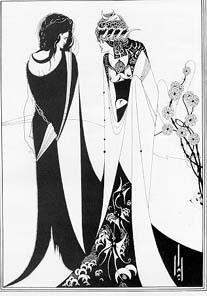
AUBREY BEARDSLEY


Aubrey Beardsley was an illustrator and became known in the larger context of Art Nouveau. In criticizing Victorian society, Beardsley focused on the sexual sphere. He was fully aware that challenges to Victorian values came not only from the avant-garde, but from the Women's Movement, which by the 1880's, had made some gains in the areas of education and economic rights. Through his bizarre and symbolic style, Beardsley's drawings blur gender lines and mock male superiority. They also play on Victorian anxieties about sexual expression and men's fear of female superiority. The phrase Fin de Siecle came from the title of a French play, and became a popular expression which symbolized the mood in England from the 1870's to the turn of the century.

Interesting pictures are drawed by Aubrey Beardsley

Salome illustrations by Aubrey Beardsley

Who is Aubrey Beardsley? For futher information, click here
________________________

RICHARD STRAUSS

Richard Strauss composed the opera for the German translation of Oscar Wilde's adaptation of Salome. Strauss transformed Wilde's Salome into opera. Strauss's opera was broadly rejected at first because of the "immorality" of its content and for the heroine's disregard for the Christian morality.
If many, including Lord Alfred Douglas (Wilde's lover and the translator of the English edition, the original having been authored in French), were surprised to see Wilde's version of Salome performed on stage, Strauss's opera must have seemed appropriate given the lyricism of the text.

lunedì 7 maggio 2007

A Passage to India - Forster's 1924 novel

It's one of books which I prefer!!!


"A passage to India", written by E.M.Forster(1879-1970), is a story set in India in the early twenties. Forster begins to write this book, that is his last novel, during his first visit to this country. His interest in human relationships seems to be developed during his years at the King's College in Cambridge.
In this novel, Forster underlines the enormous difference between the Indian and the English culture.This book mainly points out the behaviour of superiority that the British rulers have towards the Indian people.The conditions of life of the English colonies in India are really difficult and the poverty is too much. So Forster tries to show the dramatic situation of an English colony: Chandrapore.
The novel tells the story of a young English lady, called Adela Quested, who has come to Chandrapore to visit her future husband, the City Magistrate. During this travel, she makes acquaintance with a young Muslim doctor, Aziz, who organises an expedition to the Marabar Caves for Adela and the City Magistrate's mother, Mrs. Moore. In the visit to the Caves there is terrible accident: Adela accuses Aziz of attempting to rape her inside the Caves. So trial is made against the doctor, but during this, Adela suddenly reveales that she is wrong and the accusation against the doctor is unfounded. Aziz is released and this represents an important victory for India on English superiority.
Adela has a very strange personality. She seems interested in the Indian culture and ways of life but she also seems disturbed or almost scared of this. During the visit to the caves, during the trial and during her ride by bicycle we can see her weak psychology and her confusion that at a wide exent brings her to invent and to imagine that she has been raped by Aziz, her Indian friend. At the trial she asks herself: "In virtue of what had she collected this roomful of people together", but she can't find a reason. She feels herself upset and at a moment "Her body resented being called ugly, and trembled." During the trial, "while the prosecution continued, Miss Quested examined the hall - timidly at first as though it would scorch her eyes". When she is called to testify, she shows herself timorous and uncertain, almost feared of speaking. Her mind is full of confused images. "Her vision was of several caves. She saw herself in one, and she was also outside it, watching its entrance, for Aziz to pass in. She failed to locate him. It was the doubt that had often visited her, but solid and attractive, like the hills, ' I am not- ' Speech was more difficult than vision. ' I am not quite sure' ". Adela can't speak and she really feels too insecure. She doesn't know anymore what she has to say and what she thinks. Suddenly she organizes her ideas and she understands what she really has to say . So she explains that she is wrong. This revelation is very important: Aziz is in her hands and the British rulers only wait for his condemnation because he is an Indian.
However, the story has a happy end, even if the human relationship - even that of the most open-minded characters - in the end fails to overcome cultural and social barriers. An only doubt remains: what influenced Adela? Too much sun, as Aziz says to Mr. Fielding, her weak and strange personality or the sense of English superiority?

MAJOR CHARCTERS

DR. AZIZ - an Indian Muslim doctor. He is a widower who loved his wife so much that he has refused to agree with his mother's suggestions that he should remarry. He begins as a gentleman who accepts the English rulers and tries to live according to their dictates, although not happily.

RONNY HEASLOP - a British District Magistrate. He is the son of Mrs. Moore and fiancé of Adela Quested. He has neither sympathy nor understanding of India, the Indian culture, or the attitude of the Indians to life. He believes that the only way to rule the Indians is by subduing them, controlling them, and even insulting them on occasions.

MRS. MOORE - an elderly British woman, who is the mother of Ronny Heaslop. She believes that people are born to love one another. She is shocked and unhappy about her son's attitude to Indians and dismayed at the behavior of many people in India.

ADELA QUESTED - the British fiancée of Ronny Heaslop. She comes to India with Mrs. Moore as a prospective bride for Ronny. She, like her future mother-in-law, is a sensitive person who does not like the behavior of the British in India. She is interested in learning about India and rather ambivalent about her engagement. She falls victim to her own imagination.

CYRIL FIELDING - the Principal of Chandrapore College, where young Indians are educated in the British style. There is no feeling of racial superiority in him. He is also scholastic, believes in the value of education, and is popular with his students. The English men tolerate him, but English women dislike him because he is not a real Sahib.

RALPH and STELLA - the children of Mrs. Moore by her second marriage. They are left in England during Mrs. Moore's trip. Forster does not develop their characters, and they are presented only towards the end of the novel. Stella Moore is married to Fielding, who confides to Aziz that his wife is inclined towards the spiritual. Ralph is an idiot savant.

MAJOR THEMES

- superiority towards the Indians
- cross-cultural relations
- physical passage between India and England (the Suez Canal, which opened in 1902, made it possible for the English to make their geographic passage to India in about six to eight weeks, considerably less time than previously possible)
- a journey to friendship and loyalty between people from differing cultures
- love is the key to establishing true human relationships
- different kinds of relationships are explored -- between mother and son, between a young man and woman who are engaged, between Hindus and Muslims, among Hindus themselves, between the British and the Indians, and among the British themselves.
____________

There's also a film aout it. It's very nice:

lunedì 30 aprile 2007

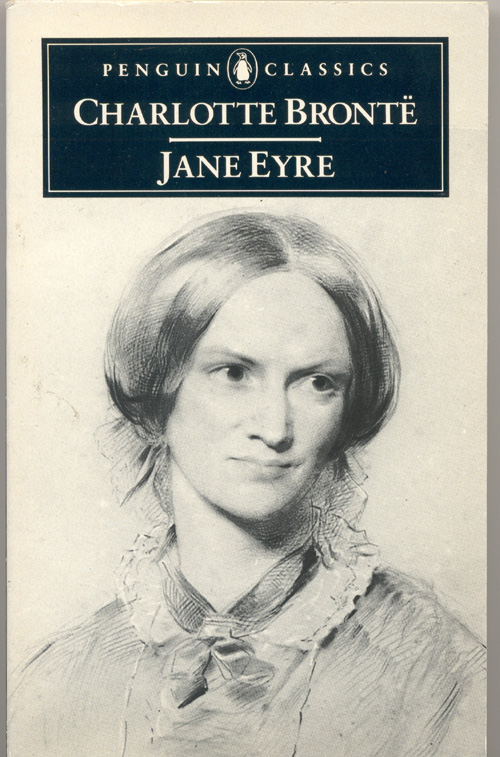
Jane Eyre - Charotte Bronte


Orphaned into the household of her Aunt Reed at Gateshead and subject to the cruel regime at Lowood charity school, Jane Eyre nonetheless emerges unbroken in spirit and integrity. She takes up the post of governess at Thornfield Hall, falls in love with Mr. Rochester, and discovers the impediment to their lawful marriage in a story that transcends melodrama to portray a woman's passionate search for a richer life than that traditionally allowed women in Victorian society.

Until the age of 10, Jane Eyre grew up with her abusive aunt and cousins. She was then sent to Lowood where the conditions were unlivable. It wasn't until Jane turned 18 that she saw hope in her future as a governess for a French coquette. When Jane arrives at Thornfield, her world is completely changed: amidst a mystery of the house and a friendship with the matron of the house, Jane finds herself in love with the master of the house. Thornfield promises to change her life forever.

Jane Eyre is obviously written from the first person point of view or "I". When the novel was initially published, the subtitle was An Autobiography. The subtitle was dropped in subsequent editions of the novel. In general, a first person point of view has the advantages of being a constant point of view and helping to make the work consistent; also, it tends to give authority and credibility to the narrative, since the person telling the story observed and/or was involved in all the incidents. Its drawbacks are that the story is limited to what the narrator saw or heard and to the narrator's interpretation of the other characters. Because the action is completed before the story begins, the narrative may not be as vivid as fiction using other points of view, and the characters and action may seem more distant. Jane Eyre has the virtues of this method; most readers accept Jane's interpretation and explanations of herself, the other characters, and events. However the problem of too great an aesthetic distance does not arise. Jane's emotional intensity and openness cause the reader to identify with her, so that her experiences and feelings temporarily become those of most readers.

SETTINGS:

Jane Eyre makes particularly powerful and complex uses of setting, which it intertwines with plot, characterization, and, of course, symbolism and imagery.
The setting of the story is carefully divided into five distinct locales, each of which has its particular significance in Jane's history and each of which is like an act in a five-act drama. Her early childhood is spent in Gateshead Hall, the home of the Reeds; from there she goes to Lowood, where she comes under the influence of Mr. Brocklehurst, Miss Temple, and Helen Burns; as governess to Adele at Thornfield she falls in love with Rochester; after the discovery of the existence of Bertha, Jane runs away and is taken into Moor House, the home of her cousins, the Rivers family; in the conclusion of the book she and Rochester are united at his crumbling hunting-lodge, Ferndean Manor. There are, in addition, two scenes in which Jane returns to an earlier home to discover changes in both herself and those she has known in the past: from Thornfield she returns to the deathbed of Mrs. Reed at Gateshead, and from Moor House she returns to Thornfield to find only its blind windows and gaping walls.

MAIN CHARACTERS:

JANE EYRE: An orphan who spends her unhappy childhood under the care of her aunt. She is sent away to Lowood for her education and later becomes a teacher there. At Thornfield Hall, where she serves as a governess, she forms an attachment to Mr. Rochester, the wealthy owner of the estate. The relationship is a troubled one, and Jane finally leaves Rochester. After Jane seeks and finds "family," she slowly forms, through deprivation and poverty. She triumphs over various difficulties eventually returns to Mr. Rochester, who is then blind and disfigured, and they enjoy a quiet and happy married life.

EDWARD FAIRFAX ROCHESTER: The second son of a wealthy landowner. He has a gruff, self-important manner. He has lived an interesting life, filled with travel and adventure. His attitude towards Jane is at first vague and questionable. He then grows affectionate with her; finally, he treats her with the honour she deserves. Mr. Rochester is married to Bertha Mason, an insane woman whom he hides in the attic of Thornfield Hall. Since Jane does not know about Bertha, she accepts Mr. Rochester's proposal of marriage. After his wife's death and his own disfigurement, he is quite humbled, and when he marries Jane, he is a changed man.

ST JOHN RIVERS: A young minister at Morton who lives at Marsh End. He saves Jane from starvation after she runs away from Thornfield Hall. He has a generous impulse towards the poor, but Jane suspects that he does not perform his work with much real feeling. He wants to marry Jane, but she rejects him.

MINOR CHARACTERS:

SARAH GIBSON REED: The widow of Jane Eyre's uncle. She treats Jane badly, preferring to indulge her own children. Jane resents her.

JOHN REED: The pampered son of Sarah Reed. He is a source of anxiety for his mother and enjoys tormenting Jane. He suffers a violent death at a young age.

ELIZA REED: The elder daughter of Sarah Reed. She is cold and indifferent to her dying mother. She becomes a nun and attains the position of mother superior.

GEORGIANA REED: The second daughter of Sarah Reed. She marries a wealthy man in London.

MISS TEMPLE: The superintendent of Lowood. She is one of the few adults in Jane's childhood who treats her with anything like affection. Jane truly loves Miss Temple, and when Miss Temple marries, Jane feels abandoned.

MR BROKELEHURST: A hypocritical clergyman who oversees Lowood School and is cruel to Jane.

HELEN: An ill, motherless girl at Lowood School. With her tender, ethereal qualities, she becomes Jane's friend and first confidante. Many years after Helen's death, Jane erects a gray marble tablet over her grave, in fond remembrance of her friend.

CELINE VARENS: A French performer who was Mr. Rochester's mistress during his time in Paris. The relationship between the two ends when she deceives him.

BERTHA ANTOINETTA MASON: The beautiful woman Mr. Rochester married in the West Indies. She is imprisoned in the attic of Thornfield Hall because she has lost her mind and can be violent. She kills herself after setting fire to the house.

ADELE: The daughter of Céline Varens. She is Mr. Rochester's ward. She is portrayed as coquettish beyond her years. She becomes very attached to Jane and grows into a proper young woman.

BLANCHE INGRAM: She wants to marry Edward Rochester for his wealth and social status, a desire that reveals her base and undeserving nature.

MRS FAIRFAX: The kindly housekeeper of Thornfield Hall. She treats Jane very well.

SYMBOLS:

- FIREcan be destructive, as seen in Bertha's burning of Thornfield Hall. The domestic fire is associated with human vitality, while cold and damp are associated with death. A great deal of narration is spent on the fire in Miss Temple's room. The stress is not only on the physical comfort of fire, but also on fire as a symbol of kindness, friendship and acceptance.
The fire becomes a symbol at times for a life of sacrifice and self- abnegation. St. John suppresses his passion for the charming Rosamond because of his call to the missionary life. It is almost as if his "heart is already laid on a sacred altar: the fire is arranged around it".

- The CHESTNUT TREE stuck by lightning into two halves symbolizes the fact that Jane and Mr. Rochester are to separate. The incident in which Bertha rips apart the wedding veil symbolizes Mr. Rochester's betrayal of his wife and also that of his now beloved Jane.

- The MOON is a symbol of deception. In the scene of Mr. Rochester's proposal to Jane, Jane is a victim of deception. Mr. Rochester asks Jane if she would be his beloved. Jane wants to see him, and so she asks him to turn to the moonlight because she wants to read his face. The moonlight becomes here a symbol of deception, mystery and evil.
_________________

Read the book online:
http://www.online-literature.com/brontec/janeeyre/

There's also a film on "Jane Eyre":

_________________

What do you think of the book? And what about the film? Have you ever watched it?
Do you prefer "Jane Eyre" or "Wuthering Heights"?
I like them both.

Wuthering Heights (Cime Tempestose) - Emily Bronte


Published a year before her death at the age of thirty, Emily Brontë’s only novel is set in the wild, bleak Yorkshire Moors. Depicting the relationship of Cathy and Heathcliff, Wuthering Heights creates a world of its own, conceived with an instinct for poetry and for the dark depths of human psychology.
Wuthering Heights is a romance novel about destructive passion set in the northern English moors, a place of unpredictable weather and countryside. The novel is the story of the Earnshaw family at Wuthering Heights and the Linton family at Thrushcross Grange, a neighboring property. The stage is set when Catherine Earnshaw's father brings an orphan, Heathcliff, home to be a part of their family, growing up with, but socially beneath the other inhabitants of Wuthering Heights. Catherine and Heathcliff are passionate, unpredictable soulmates who finally meet each other in a ghostly relationship in the afterlife. When Catherine's daughter, Cathy, and Hindley Earnshaw's son, Hareton, finally join happily in a loving relationship, the winter of Wuthering Heights becomes the spring of Thrushcross Grange.

FOUR MAIN CHARACTERS:

1. Heathcliff - He is a bitter man tormented by the loss of his love Catherine and the abuse of his stepbrother, Hindley. He gains the Earnshaw inheritance and sets out to ruin Edgar Linton.

2. Catherine Earnshaw - She falls in love with Heathcliff, marries Edgar Linton because of financial and social advantages and dies after giving birth to Catherine Linton.

3. Hindley Earnshaw - He is the son and heir to the Earnshaw inheritance but abuses Heathcliff and seeks to degrade Heathcliff for winning the love of Mr. Earnshaw.

4. Hareton Earnshaw - He is the son of Hindley, yet cared for by Heathcliff. In his plot to ruin Hindley and Edgar, he becomes like Heathcliff but falls in love and marries Catherine Linton.

TWO MINOR CHARACTERS:

1. Isabella Linton - She is the naive sister of Edgar and the wife of Heathcliff but later runs off to London and remains in hiding after Heathcliff throws a knife at her.

2. Linton Heathcliff - He was born in London but his mother died and he was given to his Uncle, but Heathcliff later get custody of him and marries him off to Little Cathy.

THREE MAIN SETTINGS:

1. Wuthering Heights - It was once the estate of the Earnshaws but falls into the hands of Heathcliff and mirrors his cold and grim state of mind.

2. Thrushcross Grange - It is the ostentatious home of the Lintons and impresses Catherine and transforms her into a lady.

3. London - Isabella Heathcliff runs there after having a knife thrown at her head. There she gives birth to Linton Heathcliff.

SYMBOLS AND REFERENCES:

1. Wuthering Heights - This house symbolizes anger, hatred and jealousy. As in the shown by the name, there is lot of tension within that house. The Heights mirror the conditions of its inhabitants, especially Hindley and Heathcliff.

2. Thrushcross Grange - This house contrasts with Wuthering Heights since it has the appearance one would expect from a pleasing worldly lifestyle. This appearance of this house also symbolizes the feelings of the inhabitants. Like the house, the Lintons are materialistic and superficial.

3. Hareton and Cathy - These two symbolize Heathcliff and Catherine showing what they could have become if their situations were slightly different. Both couples live in similar situations and allow for the comparison.

PLOT:

Heathcliff was a waif taken in by Mr. Earnshaw and his household. He grows bitter as he grows older falling in love with and losing Catherine. He seeks to destroy Hindley and Edgar Linton blaming them for losing Catherine. He believe that Hindley caused his loss of Catherine by degrading him. Through her marriage to Edgar Linton, Catherine becomes introduced to a world of materialism. She dies and her death fuels Heathcliff’s rage against Hindley and Edgar. However, soon after, Hindley also dies and the Earnshaw estate and Hareton fall into the hands of Heathcliff. Later, Heathcliff wins the custody of his son, Linton. He forces Cathy to marry Linton and plans to steal the Grange from Edgar through Linton. Both Linton and Edgar dies and the Grange goes to Heathcliff who now owns both Wuthering Heights and Thrushcross Grange. Heathcliff marries Hareton to Cathy trying to make Hareton fit his image. Cathy is loving to Hareton and when Heathcliff dies, both Thrushcross Grange and Wuthering Heights go to them.
______________

You can read the book online:
http://etext.library.adelaide.edu.au/b/bronte/emily/b869w/
http://www.bronte.netfury.co.uk/wuthering-heights/

You can download the whole book in here:
http://www.planetpdf.com/ebookarticle.asp?ContentID=6190

Have a good reading!!!


______________

There's also a film. It's well-done and very nice.

______________

What do you think of the book? And what about the film? Have you ever watched it?